|
I anslutning till följande
Newsletter finns en Introduktion på Svenska om Szondi Forum
NEWSLETTER
Leopold Szondi Forum. 980501
Falkenberg, (located on the Swedish Westcoast)
Dear readers,
Herewith we send you in the first place our best wishes for a
nice spring and summer. At the same time we want to inform you
about the further development of this Forum and what we know
about the Szondi movement. As you have seen we have during the
last months put in many new articles on the Forum. Moreover your
editor contacted personally different representatives of Szondi
groups. (in France, Belgium and from Romania).
My first trip was to the Szondi Institute in Zuerich where I met
Mr. Friedjung Juettner, who takes care of the international
contacts. It was Mr. Juettner who published last year an
excellent summary in German of all the five great books Szondi
with the title:
"Schicksalsanalyse in Zusammenfassungen". Die fuenf
wichtigesten Buecher L.Szondis im Ueberblick. Zuerich: Stiftung
Szondi-Institut 1997. 200 p. (ca 25:- Swfrcs) can be ordered by
contacting: szondi@bluewin.ch.
We discussed the progress of the Szondi's Institute's project for
setting up its own Szondi Information site. He informed me that
they will start to publish an Index of all the articles written
in "Szondiana", the Institute's regular publication..
The Institute's site will be opened at any date from now. As soon
as we know their internet address we will put a link to it on our
Forum.
We also discussed the possibility to put the content of these
articles as shareware on the Internet. As our German readers
might have noticed we started already publishing the first part
of an article about personality development, published in
Szondiana 1997, 17 Jahrgang, Heft 1. "Materialien zu einer
schicksalspsychologischen Entwickelungslehre" written by Dr.
H.J. Ringger. (Basic facts for a theory of Fateanalytic
psychological development.)
Another item we took up was the possibility to create a DATABANK
in which all the articles about research made up till now would
be published. A lot of unnecessary work can be avoided by having
such a databank. With such information everybody can know exactly
which research projects have already been done and by whom and
how the results were. In my opinion such a databank ought to get
the highest priority.
Mr. Juettner informed me of the possibility to have Szondi
registrations quantitatively scored by a computer program of the
Institute. The price for each such a computer scoring is 65: -
Swiss Francs. In case you are interested you can contact our link
to the Szondi Institute. Obs: The computer program itself is not
for sale.
Before leaving we showed our respect to Szondi by visiting his
grave.
A few weeks after my visit to Zuerich I flew to Geneva to meet
Dr. Ringger. The reason for my trip was that in my opinion his
article about Fateanalytical Development has a high pedagogic
value. It is very easy to read and illustrates clearly the
connection between observable behaviour and its reflection in the
Szondi test. This article is especially important for new
students who want to learn the original - orthodox -
interpretation of the Szondi-Test. It gives many examples what
can be done by the traditional way of interpretation.
I spent some days in Geneva to meet and talk with Hans-Jörg
Ringger who has forty years experience of the Szondi test,
working as a psychologist mainly with children. Fortunately he
got last year a reward for his many contributions to the Szondi
movement by getting the Institute's "Szondipreis 1997"
Dr. Ringger gave me his permission to publish several other
articles published before in the Szondiana. It was very
interesting for me to listen to him as he disposes over such an
extended knowledge of Szondi's "Fateanalysis".
Because I next year will become eighty years and Jörg Ringger is
only a few years younger we could exchange a lot of experiences
and had many hours interesting discussions. He has a lot of
natural wisdom to communicate. His outlook and his practical way
of living are wholly based on respect for Nature's laws,
"das einfache Leben". (the healthy and simple life). It
was characteristic to see many books in his library about the way
of living of the North American Indians. When he told me how he
has ordered his life I got the impression that he might be
qualified as "one of the last Mohicans". He certainly
did take the consequences of his philosophy by living according
to the laws of Nature and sacrificing much personal comfort. I
really was impressed.
The next trips during the last two weeks of April were very
hectic. My wife Gunnel Berlips and eldest son John Patrick
accompanied me. We flew to Marseilles, where we rented a car and
drove to Montpelier, in the south of France. Montpellier has a
very old university that was built 1287a.c. It has also an active
Szondi group with many members.
We had the pleasure to meet Mme. A. Gayral, secretary, Mme C.
Pithon, treasurer and Mr. G. Gomez-Suertegaray, President of the
Montpellier Szondigroup.
From them I got a computer disc with information about their
group. On this disc there was also an INDEX of all the articles
published before in their Szondi journal called
"FORTUNE". I got some paperback exemplars of Fortuna,
one about "the Susan K. Déri dossier" which contended
some unknown articles of Déri. The index and information will
soon be published on our Forum. We plan to set up a link to
"Activity Szondi groups/ Montpellier group and
Literature/French/Fortuna.
With them we discussed also the possibility to get better ways of
communication between the different Szondi groups, which have
been very much stagnant and slowed down for a long time. In case
any of you who read this would like to publish News about your
Szondi group you are welcome to send your information to us and
we will publish it on the Forum. Lets hope this Forum can
contribute to a better exchange.
After a short visit to Nice and Marseilles, (where more than
fifty years ago I worked a short period as a press photographer)
I flew to Brussels (Belgium) to meet Dr. Robert Maebe. He is my
contact person with the group around the "Centre d'Études
Pathoanalytiques" in Belgium. Robert Maebe has played a very
important part in the building up of this Forum. I would like
herewith to thank him for his assistance, generosity, knowledge
and efficiency. He has always had time to assist me when I had
questions. His encouragement has had a great positive value and
contributed much to "keep going", building up and
extending the Szondi Forum.
Dr. Maebe informed me also about the possibility TO BUY a Szondi
COMPUTER SCORING PROGRAM. At present only with French
instructions.(2) The price will be around 350 Dollars. An
advantage of this program is that the test result is illustrated
by graphics.
This program is the end product of the work of a group of
collaborators of Dr. Jean Mélon, Professor at the Liege
University in Belgium and Director of the publication
"Cahiers du Centre d'Études Pathoanalytiques". Dr.
Maebe told me that although he did a lot of testing out the
program the name of the key person behind the creation of the
program is Karl Louvet.
In case you can read Russian it might interest you to know that a
group of research assistants and programmers who work at the
laboratory of psychophysiology and professional selection of
Ukrainian "Medicine of Transport" Research Institute
also have developed a Szondi COMPUTER scoring and detailed
INTERPRETATION PROGRAM in Russian.
The director of this group is
Dr. Michail Vigdorchick. Soon I will put more information on this
Forum about this group. (link will be named: Activities Szondi
groups/Odessa)
Thanks to Dr. Maebe I got also an e-mail contact with Dr. Jean
Mélon in Liege, Belgium, who is one of the leading theoreticians
of the Pathoanlytical movement and co-author of "Dialectique
des Pulsions" (Drive Dialectics). This book, which is
written in French, gives a clear insight in the application of
Pathoanalytical thinking. It shows how Szondi¹s "Drive
Diagram" really covers and is quite in congruence with the
main orthodox psychoanalytical concepts.
"Drive dialectics" and Juettners "Summary"
are in my opinion the two important books of the Szondi movement,
which ought to get priority to be translated into English.
Just before I left for my trip I got another quite unexpected
e-mail contact with Dan Deniu, a Romanian student who belongs to
a group of about thirty Romanian students who just discovered
Szondi's Fateanalyse. They meet regularly and get instruction by
Professor Ivana Dumitru who has been in contact with Szondi many
years before. Dan Dediu informed me that - with the exception of
Suzanne Déri's French "Introduction au Test de Szondi"
- it was quite impossible to get any French Szondi literature,
even in France, all French books were sold out.
Dan Dedieu, got a short job assignment in France and we could
meet in Paris. Fortunately for this group I could inform Dan
that, just before I left, I got the permission of Dr. Jean Mélon
to publish all the French articles of the Cahiers as well as an
university course in French as shareware, to be paid after
delivery (copying). This means that all these articles (about
1000 pages French text!) can be read and copied in Romania, like
all over the world. (notice that it can take some time before I
have transferred all these articles to the Forum). Anyhow this as
another proof how the Internet can be used in a positive way by
spreading valuable knowledge.
This generous offer from Dr. Jean Mélon gives me a feeling of
personal responsibility. The reason for this is that each Cahier
is normally sold in paperback form for about averaging 500 Bfrcs,
(ca 12 Dollars each). By publishing these Cahiers on the Forum as
"shareware" the publishers of the Cahiers, (the
"Scientific Committee"), are quite dependent on the
good will of the reader who uses this Forum to pay for each copy.
I really expect that anyone who will copy these articles will
show his appreciation by paying for the articles copied to the
Secretary of the Committee. (As soon as I start to transfer these
articles you will get more information by a link to
Literature/Cahiers).
As for the planned work on the Forum:
In the next weeks I will first finish Ringgers article about
Fateanalytical psychological development. Then I will start with
the transfer of the Course of Szondi by Jean Mélon and the
French Cahiers which I expect to take quite a long time.
However I find always some consolation by the words of Freud who
said "Was man sich nicht erspringen kann soll man sich
erhinken", ("If you can¹t run, you have to hop")
-to arrive.
Before finishing this news letter I would like to thank Freek
Dhooghe and Ingrid Theunis, Belgian psychologists, for their
excellent psychoanalytical informationbas which we have linked to
our Forum.
But also I want to send my greetings and thank to my very best
Japanese friend Takahisa Yamashita for his continuous support and
encouragement right from the moment when I started with this
Szondi Forum.
We appreciate your comments!
Leo Berlips. Editor.
(1)
Because your editor is not a professional translator this text is
not perfect and I am well aware that it ought to be corrected. If
you want to assist us to get instead a fault free text please
send us your correction to >leo.berlips@motiv-analys.seyour
name<. Thank you in advance.
(2)
Data program:
Le "Logicel Szondi", outil pour l'archivage, le
diagnostic et le traitement statistique du test de Szondi. Auteur
Karl Louvet.
Pour l'application sur PC type Pentium (133 ou plus), 16 méga de
mémoire vive, un disque dur d'un Giga, une imprimante couleur.
Introduktion till svenska läsare om Szondi Forum Påsk 1998
De svenska artiklarna på Leopold Szondi Forum är baserade på
anteckningar som jag gjorde i början på sextiotalet med titeln:
"Introduktion till Szondi -testet", ca 180 sid. (1) Min
framställning är baserad på dåtidens utvecklingsnivå av
Szondi's Schicksalanalys, ("Ödesanalys). Tack vare Internet
kunde denna introduktion publiceras i slutet på 1996. Denna
serie var början till Szondi Forum.
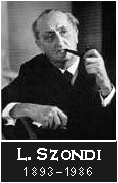
Genetikern Leopold Szondi, (1893-1986) började i mitten av
30-talet med ärftlighetsforskningar i Ungern. Vid dessa
undersökningar upptäckte han fakta som andra
ärftlighetsforskare tidigare inte hade lagt märke till. Hans
undersökningar gav honom möjlighet att avgränsa åtta
typologiska huvudgrupper, som var för sig formade en enhet med
flera karakteristiska egenskaper.
Han upptäckte att i varje grupp fanns en specifik typ av psykisk
sjukdom som dominerade, men dessutom att flera andra sådana för
varje grupp karakteristiska företeelser kunde påvisas.
Särskilt gällde detta val av äktenskapspartner. Det visade sig
att medlemmarna inom samma grupp gifte sig mer med varandra än
med utomstående trots att de ofta var omedvetna om att de
tillhörde samma grupp. Sådana typer av preferensval upptäcktes
i varje grupp även på andra områden. ( t.ex i val av yrken
eller i specifika intressen för t.ex. teknik, vetenskap, kultur,
musik, teater o.d.)
Den första gången som Szondi upptäckte detta samband mellan
psykisk sjukdom och partnerval var när han, tillsammans med en
manlig patient höll på att ställa upp ett familjeträd.
Såväl Szondi som patienten blev helt överraskade när de
upptäckte att samma ovanliga psykiska sjukdom som patientens
mamma led av också påträffades i patientens frus närmaste
familj. Detta blev den tändande gnistan till Szondi's forskning.
Sambandet mellan affinitet till specifika yrken och psykiska
sjukdomar påvisades. Detta gällde även de erkända
psykosforskarna som Bleuler, (som faktiskt gav upphovet till
begreppet Schizofreni), C.G. Jung och Bingswanger,(
Daseins-psykologins upphovsman).
Under tiden 1936 till 1963 skriver Szondi fem stora böcker, med
tillsammans ca 2500 sidor, om sina upptäckter. De åtta
huvudgrupperna delas in och definieras enligt varje grupps mest
karakteristiska psykiska sjukdom.
Följande psykiska sjukdomar avgränsades som norm för varje
grupp:
1. Hermafroditism (h); 2. Sadism; (s); 3. Epilepsi (e); 4.
Hysteri (hy),
5. Katatoni (k); 6. Paranoia (p); 7. Depression (d); 8. Mani (m).
Szondi framställde de behov som hade samband med dessa
sjukdomar,
tillsammans kopplade i fyra par, i ett psykoanalytiskt
DRIFTDIAGRAM på
följande sätt:
I. SEXUAL-Vektor uppbygd av faktor (h) och faktor (s)
II. AFFEKTKONTROLL (Paroxysmal)- Vektor uppbygd av faktor (e) och
(hy)
III. JAG(Sch) Vektor uppbygd av faktor (k) och (p) och
IV. CONTACT- Vektor uppbyggd av faktor (d) och (m)
(se länk till: General Information/swedish/ÖDESANALYSENS
DRIFTSYSTEM).
I Sverige har Szondi's teori använts i många år för
rådgivning avseende yrkesval i form av ett djuppsykologiskt
inriktat Yrkesvaltest: "der Berufberatungstest"
(BBT-test, bearbetning av Mary Norman). Testets upphovsman är
Dr. Martin Achtnich. Han använder Szondis åtta behovsfaktorer
som indelning för hans bilder av olika yrken.. Dessa faktorer
(behovsradikaler) som uttrycker allmänna mänskliga behov
beskrivs av Achtnich i nedanstående tabell. Han har översatt
Szondis psykiatriska beteckningar till mera lättillgängliga
begrepp:
1. Vekhet (WEICHHEIT), har samband med Szondi-faktor (h).
2. Styrka (KRAFT), Szondi-faktor (s).
3. Affekt kontroll, Socialt sinnelag (SOZIALA GESINNUNG.)
Szondi-factor
(e). Som har två funktionsaspekter:
- Hjälpberedskap: har samband med (e+) och
- Energi: har samband med (e-)
4. Att synas (ZEIGEBEDURFNIS), Szondi-faktor (hy). Behovet att
bli sedd och att visa upp sig (hy+) eller att se/betrakta (hy-)
5. Förstånd (VERNUNFT): Szondi-faktor k) Människan har ett
behov av att avgränsa sig och att förstå världen.
6. Idéernas värld. (GEIST): Szondi-faktor (p) Själslighet
(andlighet). Intuition. Behovet av kreativitet och annan psykisk
verksamhet.
7. Materia (MATERIA): Szondi-faktor (d) Materia, substans. Det
konkret, fattbara, gripbara.
8. Oralitet (ORALITET), Szondi-faktor (m) Oralitet, allt som har
med munnen att göra. Människor med detta behov förväntar sig
få något, som har med nöje, njutning och stöd att göra. I
grunden finns ett behov, som kan vara en tillgång för
etablerandet av sociala kontakter.
BBT-testet kan beställas hos Psykologiförlaget (se vår länk)
I Sverige har organisationskonsulten Rolf Kenmo sedan 1986,
utvecklat ett Szondi-baserat test- och utvecklingssytem ( som kan
användas för individ- och team-utveckling.(2 ) Rolf Kenmo är
den som, enligt min uppfattning, har lyckats bäst med att hitta
en enkel och lättbegriplig terminologi som kan användas i det
praktiska vardagslivet. Faktorerna får då följande begrepp:
* relation (h)
* kraft (s)
* kvalité (e)
* exponering (hy)
* struktur (k)
* fantasi (p)
* stabilitet (d)
* kontakter (m)
Kenmo anser att framgången med hans utvecklingssystem baseras
på det faktum att han använder Szondis behovssystem. I
introduktionen skriver han: "Varje människa kan anses ha
olika styrka av dessa åtta allmänmänskliga behov. Dessutom
varierar styrkan över tiden. Om ett behov är väl mycket
tillgodosett under en tid, så blir det dämpat sedan. På samma
sätt kan man få brist i behovstillfredsställelse och blir då
mer och mer desperat i sin iver att få behovet tillgodosett.
Emellertid så har alla en specifik egen behovsprofil, som
variationerna utgår från. Varefter en människa utvecklas över
åren, så kan behovsprofilen ändras. När någon går till
överdrift med ett behov, så kan man säga att den människan
når ett extremvärde och då inträffar ett psykiskt
sjukdomstillstånd."
Se vidare enligt länken "Szondi Application/
"Questionnaire"
Szondi själv hade redan vid slutet av 1940-talet utvecklat sitt
s.k. Szondi-test baserat på denna indelning i åtta
behovsgrupper. Utvecklingen av testen hade samband med faktum
att, i början av hans undersökningar, den vanliga metoden för
släktforskning var att ställa upp ett familjestamträd. Detta
var en ytterst tidskrävande metod. För att minska
undersökningstiden kom Szondi på den intressanta idén att i
stället be försökspersonen att välja mellan fotografier av
psykisk sjuka, som var och en tillhörde en av dessa åtta
grupper. Det blev sex serier av åtta fotografier som man kan
identifiera resp. kontra-identifiera sig med.
Szondi ansåg att människans grupptillhörighet hade samband med
överföringen av en, för varje grupp specifik, gen. Szondis
genteori blev starkt kritiserad, när han efter Andra
Världskriget publicerade sina resultat. Kritiken berodde delvis
på faktum att ärftlighetsteorier hade använts för
judeförföljelser.
Upphovsman till en ny tillämpning av Szondis teorier, den
belgiska prof. Jacques Schotte (Université catholique de
Louvain), har pekat ut att man slipper oändliga och ofruktbara
diskussioner genom att uppfatta "genen" som en metafor
för driften.
Dessutom hänvisade Schotte till Freuds "Principen om den
brutna kristallen" Han påpekade att Szondi, utan att vara
medveten om det, i praktiken bevisade riktigheten i Freuds
uppfattning att det finns karakteristiska brytningslinjer
(frakturlinjer), som även gäller för det normala mänskliga
psyket.(3)
Baserat på denna insikt har Schotte tillsammans med en grupp
belgiska och franska psykiater vidareutvecklat Szondi´s teorier.
Denna nya strömning, som började i mitten av sjuttiotalet, fick
den franska beteckningen "PATHOANALYS". Sammanfattning
av deras undersökningar publiceras kontinuerligt på Szondi
Forum på olika språk, ta länk till "NEW
DEVELOPMENTS".
För att lära känna Szondis personlighetsteori finns
introduktionsartiklar på svenska, välj då länken
"General Information/swedish" på Forums första sida.
Där kan man också få information om hur man tolkar testet
under rubriken: "C- vektorn, Kontaktvektorn" - som
handlar om hur det inom denna vektor finns 16
tolkningsmöjligheter av dialektiken mellan de orala och anala
behoven. För att få en bättre insikt i Szondis teori om Jagets
uppbyggnad kan man t.ex. ta länken till:
"Jagfunktionerna" (projektion, introjektion, negation
och inflation).
Det är min förhoppning att Ni, liksom Schotte kommer till
slutsatsen att: "Szondi kan betraktas som den största av de
obekanta analytiker och den mest obekante av de stora".
Leo Berlips. Leg. Psykolog, leg. Psykoterapeut, Psykodrama
terapeut.
(1)
Det finns även en bra sammanfattning på Tyska:
"Schicksalsanalyse in Zusammenfassungen"
Die fuenf wichtigsten Buecher L.Szondis im Ueberblick" von
Friedjung
Jüttner. (25 Sw.frcs) kan beställas hos oss.
(2)
Utvecklingen har gjorts i samverkan med psykologen
Lars-Erik Liljeqvist samt psykologerna Bo Haglund,
Arbetslivstjänster,
Borlänge och Mary Norman, AMI, Tullinge.
(3)
I "Principen om den brutna kristallen". skrev Freud:
"Där det i patologi pekas på en spricka eller fraktur kan
det redan i normalt tillstånd finnas en artikulation. Om vi
kastar ner en kristall på golvet faller den sönder, men inte i
bara på ett slumpartat sätt. Det faller sönder i brottstycken
enligt bestämda klyvningslinjer. Trots att deras gränslinjer
var osynliga var de redan i förväg bestämda av kristallens
struktur. Det vad vi kallar psykiska sjukdomar motsvarar sådana
kluvna strukturer. I varje fall av psykisk sjukdom kan man iaktta
en av dessa möjliga frakturlinjer av det mänskliga
psyket".
Neue Folge der Vorlesungen zur Einfuehrung in die
Psychoanalyse, 31. Vorlesung, paragraaf 4, G.W., Bd. 15, IV + 207
pag. (1931)
(4)
Ni som läser franska hänvisar jag särskilt till boken
"Dialectique des Pulsions". Innehållet beskriver hur
det nya "pathoanalytiska" synsättet påvisar att
Freuds ortodoxa psykoanalys fullt motsvaras av Szondis
driftdiagram.
DIALECTIQUE DES PULSIONS, 3" édition par Philippe Lekeuche
et Jean Mélon. Edition De Boeck-Wesmael s.a., 1990. 203 Avenue
Louise - 1050 Bruxelles. Belgique. (se närmare beskrivning på
Forum: Litteratur, French, Biblografie, Index 1.)
|